
Series 3: The Forbidden Experiment
Part 1
The Greek historian Herodotus describes how the Egyptian Pharaoh Psamtik I conducted a strange and cruel investigation into the origins of language.
Part 1
The Greek historian Herodotus describes how the Egyptian Pharaoh Psamtik I conducted a strange and cruel investigation into the origins of language.
Part 2
The Holy Roman Emperor and amateur ornithologist Frederick II was alleged to have conducted a linguistic experiment similar to that of Psamtik. I explore that rumour in the context of medieval ideas about the origin of language.
Part 2
The Holy Roman Emperor and amateur ornithologist Frederick II was alleged to have conducted a linguistic experiment similar to that of Psamtik. I explore that rumour in the context of medieval ideas about the origin of language.
Part 3
Our third rumour of this depraved linguistic experiment takes us to an uninhabited island in the Firth of Forth, where, in 1493, King James IV of Scotland is said to have emulated Psamtik I and Frederick II. Continued in the next episode.
Part 3
Our third rumour of this depraved linguistic experiment takes us to an uninhabited island in the Firth of Forth, where, in 1493, King James IV of Scotland is said to have emulated Psamtik I and Frederick II. Continued in the next episode.
Part 4
Following on from the episode on James IV's experiment, this episode investigates why it might have seemed plausible at the time that the children would end up speaking Hebrew, by looking at the rumour's context in Renaissance linguistics, bringing in characters such as a linguist who thought an Italian nun was a female equivalent of Jesus Christ, and another who claimed that the language spoken in the Garden of Eden was an early form of Dutch.
Part 4
Following on from the episode on James IV's experiment, this episode investigates why it might have seemed plausible at the time that the children would end up speaking Hebrew, by looking at the rumour's context in Renaissance linguistics, bringing in characters such as a linguist who thought an Italian nun was a female equivalent of Jesus Christ, and another who claimed that the language spoken in the Garden of Eden was an early form of Dutch.
Part 5
The Mughal Emperor Akbar the Great's conquests led to him ruling most of the Indian Subcontinent - and he became obsessed with learning everything he could about the various religions practiced in his Empire. But amid his religious enquiry, he's said to have conducted another, more sinister investigation, into the mechanisms of language acquisition.
Part 5
The Mughal Emperor Akbar the Great's conquests led to him ruling most of the Indian Subcontinent - and he became obsessed with learning everything he could about the various religions practiced in his Empire. But amid his religious enquiry, he's said to have conducted another, more sinister investigation, into the mechanisms of language acquisition.
Part 6
Where did Akbar the Great get the idea for the experiment from? Given that he didn't have access to Herodotus, this episode looks at precedents in Ancient Indian and Medieval Islamic thought, before moving on to how questions of language acquisition and the origin of language developed since Akbar's time, bringing in a 'Wild Boy' from the South of France, several people claiming to have had languages revealed to them by God, and something called the 'Yo-He-Ho Theory'.
CW: This episode includes descriptions of real instances of severe child abuse
Part 6
Where did Akbar the Great get the idea for the experiment from? Given that he didn't have access to Herodotus, this episode looks at precedents in Ancient Indian and Medieval Islamic thought, before moving on to how questions of language acquisition and the origin of language developed since Akbar's time, bringing in a 'Wild Boy' from the South of France, several people claiming to have had languages revealed to them by God, and something called the 'Yo-He-Ho Theory'.
CW: This episode includes descriptions of real instances of severe child abuse
Images
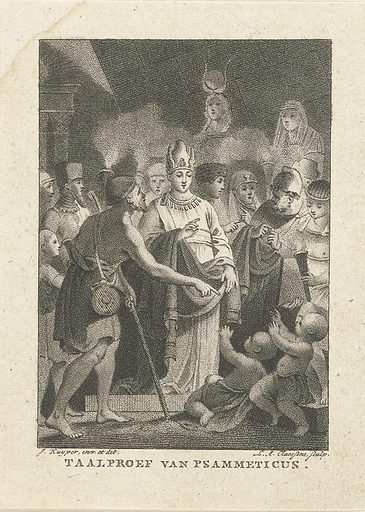
An engraving from 1800 by Lambertus Antonius Claasens, illustrating Psamtik witnessing the outcome of his supposed experiment.
Source: Rijksmuseum
Carl Sagan, in Cosmos, demonstrating an Ancient Greek Clepsydra, as described by Empedocles (he claims that Empedocles used this to prove the existence of air, which is not correct).
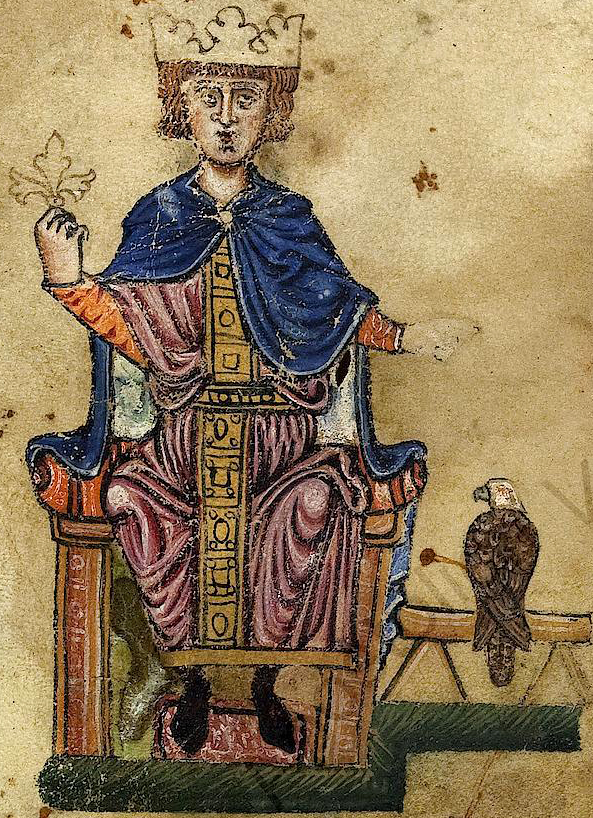
A picture of Frederick II with a bird of prey, from a late 13th-Century manuscript of De Arte Venandi Cum Avibus, his book on ornithology.
Source: Wikimedia Commons

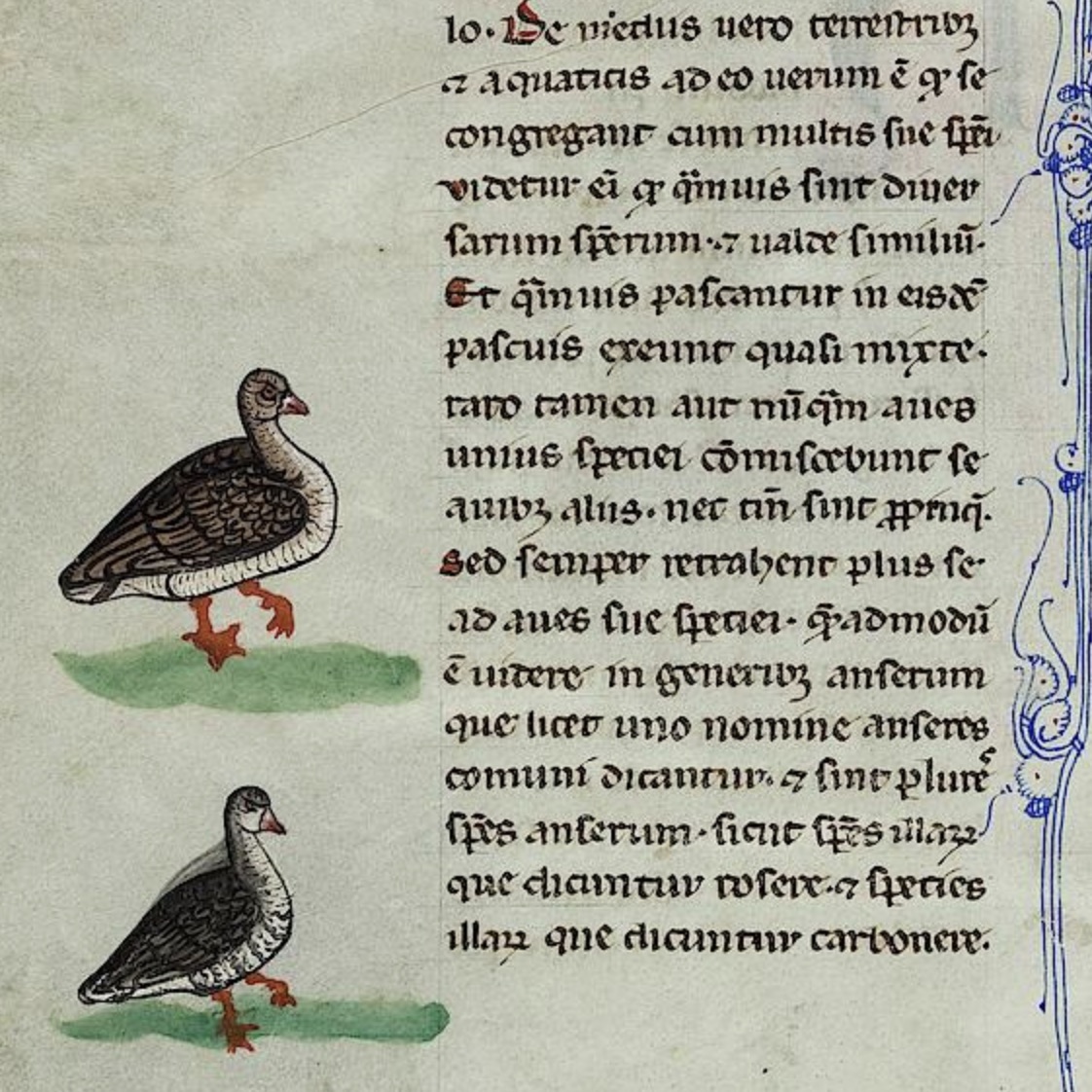
A page from De Arte Venandi cum Avibus, with pictures in the margins of barnacle geese. In the book, Frederick describes an investigation debunking the Medieval myth that barnacle geese formed from barnacles on the planks of ships in the Arctic.

Litterae Ignotae ("Unknown Letters"), the constructed alphabet created by Hildegard of Bingen to write the Lingua Ignota
("Unknown Language"), a constructed language that she claimed was revealed by God. This key is from a manuscript c. 1200.
Source: Wikimedia Commons

Sources
Primary Sources
Herodotus (c. 430 BCE), Trans. A. Godley (1920). The Histories. Full text available from the Perseus Digital Library
Empedocles (5th Century BCE), Trans. William Ellery Leonard (1908). Fragments of Empedocles. Full text available from the Internet Archive
Aristotle (350 BCE), Trans. R. P. Hardie & R. K. Gaye: Physics Full text available from the Internet Classics Archive
Anonymous (c. 400 BCE), Trans. Rosamond Kent Sprague (1966): Dissoi Logoi Full text available from Binghampton University.
Plato (c. 360 BCE), Trans. Benjamin Jowett: Cratylus Full text available from Project Gutenberg.
Epicurus (4th Century BCE), quoted in Sean (2012): Ancient Theories of Language Evolution: The Origin of the Monolingual Myth.
Epicurus (4th Century BCE): Letter to Herodotus, trans. C.W. Chilton (1962), quoted in Sean (2012): Ancient Theories of Language Evolution: The Origin of the Monolingual Myth.
Diodorus Siculus (1st Century BCE), Trans. G. Booth (1814): Bibliotheca Historica (Book I) Full Text available from Wikisource.
Lucretius (1st Century BCE), Trans. W.H.D. Rouse, Rev. W.F. Smith (1924): De Rerum Natura (Book v), Quoted in Przemysław Żywiczyński (2018): Language Origins: From Mythology to Science. Full Text (Preprint). Original Translation available from the Internet Archive. Revised version available from the Loeb Classical Library.
"Augustine of Hippo (426 CE), Trans. Marcus Dodds (1871): The City of God (Vol. II, Book XVI). Full Text available from Project Gutenberg.
Salimbene di Adam (1287), Trans. Joseph L. Baird, Giuseppe Baglivi & John Robert Kane (1986): The Chronicle of Salimbene de Adam. Full Text available from the Internet Archive.
Frederick II (1248), Trans. Casey A. Wood & F. Marjorie Fyfe (1943): The Art of Falconry: Being the De Arte Venandi cum Avibus of Frederick II of Hohenstaufen. Full text available from the Internet Archive.
Isidore of Seville (c. 630 CE), Trans. Stephen A. Barney, W.J. Lewis, J.A. Beach & Oliver Berghof (2006)The Etymologies of Isidore of Seville. Full Text
Dante Alighieri (c. 1305), Trans. Steven Botterill (1996): De Vulgari Eloquentia Full Text available from Dante Online.
Dante Alighieri (c. 1321), Trans. Henry Wadsworth Longfellow (1867): The Divine Comedy: Paradiso. Full Text available from Project Gutenberg.
Marriage Certificate of Thomas Tillsye and Ursula Russell:
Hildegard of Bingen (12th Century), quoted in Corvusfugit (2018): 12th Century: The Unknown Language.
Robert Lindsay of Pitscottie (1575), ed. A.J.G. Mackay (1899): The Historie and Cronicles of Scotland. Full text available from the Internet Archive.
John Leslie (1570), ed. T. Thomson (1830): The History of Scotland. Full Scots text available from the Internet Archive.
William Dunbar (16th Century): A Ballad of the Friar of Tungland. Full Scots text available from the All Poetry.
Pedro de Ayala (1497). Letter to King Ferdinand. Quoted in Ralph Griffiths (2003). 'The island of England in the fifteenth century: perceptions of the peoples of the British Isles'. Journal of Medical History. Available from academia.edu.
Secondary Sources
Antoni Sułek (1989). "The Experiment of Psammetichus: Fact, Fiction, and Model to Follow". Journal of the History of Ideas Vol. 50, No. 4. Available from JSTOR.
Robin Campbell, Robert Grieve (1982). 'Royal Investigations of the Origins of Language'. Historiographica Linguistica. Available from ResearchGate.
Tyler Mayo (2019). 'Research and Experiment in Early Greek Thought'. University of Michigan. PhD Dissertation. This was available for free online at the time of writing the first episode of this series, but it no longer appears to be.
Alan Lloyd (1988). 'Herodotus' Account of Pharaonic History'. Historia: Zeitschrift für Alte Geschichte. Available from JSTOR.
Sean (2012). Ancient Theories of Language Evolution: The Origin of the Monolingual Myth.
Przemysław Żywiczyński (2018): Language Origins: From Mythology to Science (Preprint).
Sten Ebbesen (2017): 'Psammetichus's Experiment and the Scholastics. Is Language Innate?' in I J. Pelletier, & M. Roques (eds.): The Language of Thought in Late Medieval Philosophy, Essays in Honor of Claude Panaccio (pp. 287-302). This was available for free online at the time of writing the first episode of this series, but it no longer appears to be.
Alec Ryrie (2019): Unbelievers: An Emotional History of Doubt
Joseph (2015): Letter? I ‘ardly know ‘er: The unknown language (and letters) of Hildegard von Bingen.
Donald Guthrie (1953): 'The Medical and Scientific Exploits of King James IV of Scotland'. The British Medical Journal. Available from JSTOR.
William Lithgow (1875): The Biographical Dictionary of Eminent Scotsmen. Full Text available from <. Wikisource.